Proudly serving Upstate South Carolina and surrounding areas






Tankless Water Heater: Is It Worth the Switch?
Serving Upstate South Carolina with trusted home comfort solutions since 1970.

4.8 Google Rating

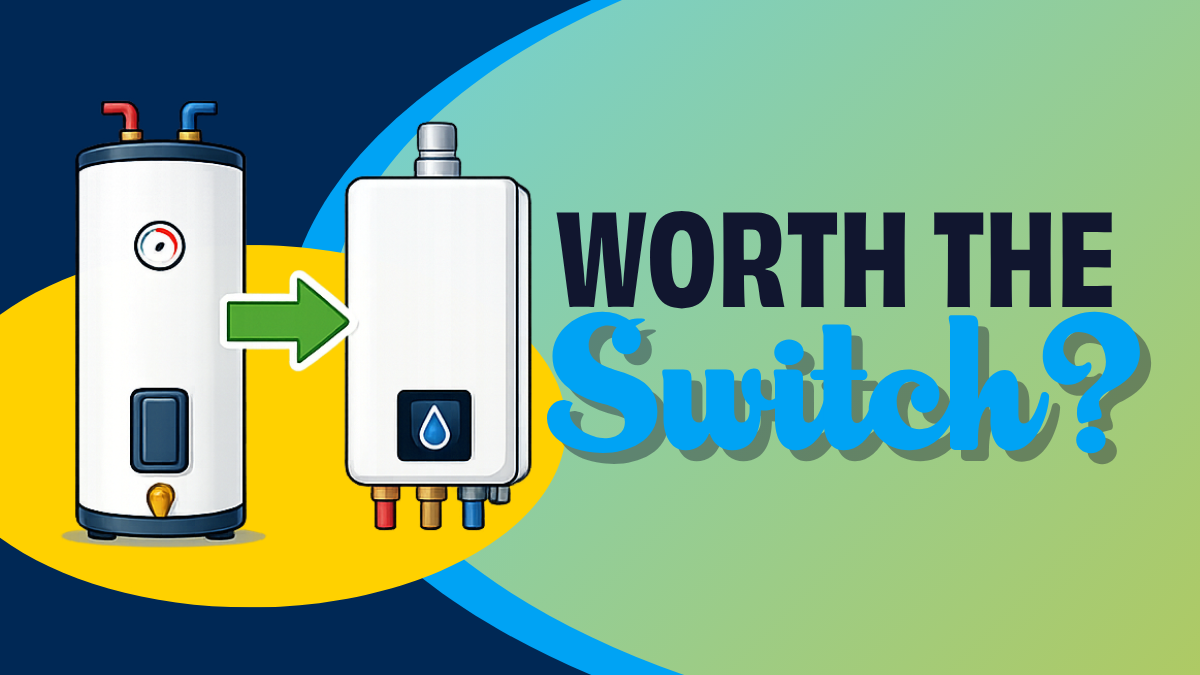
Every few weeks, a homeowner calls us and says, “My water heater’s dying. Should I just go tankless?” It’s a fair question — and the honest answer is: it depends on your home, your family, and how you use hot water.
I’m Jamie with Waldrop Plumbing Air Electric, and our plumbing team installs both traditional tank and tankless water heaters across Upstate South Carolina. I’m going to give you the real story — not the manufacturer sales pitch, not the “tankless is always better” hype. Just the facts so you can make a smart decision.
What Is a Tankless Water Heater?
A traditional water heater keeps 40-80 gallons of water hot 24/7, whether you need it or not. It’s like leaving your oven on all day in case you want to cook something.
A tankless water heater (also called an on-demand water heater) heats water only when you turn on a faucet. Cold water flows through the unit, passes over a heat exchanger, and comes out hot. No storage tank, no standby energy loss.
The Real Pros of Going Tankless
1. Endless Hot Water
A tankless unit will produce hot water for as long as you need it. Take a 45-minute shower if you want. No cold water surprise.
For larger families in the Upstate, this is a game-changer. If you’ve got four kids and everyone needs a shower before school, a tank water heater can’t keep up.
2. Energy Savings (But Let’s Be Realistic)
The Department of Energy says tankless water heaters are 24-34% more efficient for homes that use 41 gallons or less of hot water per day. For homes using more, savings are around 8-14%.
For an average Upstate SC family, that translates to roughly $75-$150 per year in energy savings. Real money over the life of the unit, but not the dramatic savings some companies promise.
3. Space Savings
A tank water heater takes up a 2×2-foot footprint in your garage, basement, or closet. A tankless unit mounts on a wall and is about the size of a carry-on suitcase. In older Upstate homes where space is at a premium, that’s significant.
4. Longer Lifespan
Tank water heaters typically last 8-12 years. Tankless units last 15-20 years with proper maintenance. Over a 20-year period, you’d replace a tank heater twice but a tankless unit once.
5. No Tank Failure Flooding Risk
When a tank water heater fails, it can dump 40-80 gallons of water on your floor. Our tech Blake has seen water damage from failed tank heaters that cost homeowners thousands in repairs. A tankless unit eliminates that risk.
The Real Cons (And Why Tankless Isn’t Always the Answer)
1. Higher Upfront Cost
Tankless can be 2-3x the upfront cost of a traditional tank water heater. The energy savings are real, but it takes 8-12 years to break even on a gas tankless unit, and longer on electric.
2. The “Cold Water Sandwich”
When you turn on hot water, there’s a brief delay (usually 10-15 seconds) while the unit fires up. Then you get a short burst of warm water (leftover from the last use), followed by a slug of cold water, then hot water flows steadily.
3. Your Gas Line May Need an Upgrade
Gas tankless water heaters require significantly more BTU input than tank heaters. If your existing gas line is ¾-inch (common in older Upstate homes), it may need to be upgraded to 1-inch to feed the tankless unit.
4. Hard Water Issues (This Is Big for Upstate SC)
Here’s something specific to our area. If you have hard water or well water, which is common in rural parts of Greenville, Spartanburg, Laurens, and Anderson counties, tankless water heaters require more maintenance.
Hard water causes mineral buildup on the heat exchanger. Tank heaters are affected too, but the buildup on a tankless heat exchanger reduces performance more dramatically. Without annual flushing (or a water softener), a tankless unit in a hard water area will lose efficiency and can fail prematurely.
5. Electric Tankless Has Limitations
Electric tankless water heaters are cheaper than gas models but have one major drawback: they can struggle to raise water temperature enough during winter. When incoming water in January is 45-50°F (typical for SC groundwater temps), an electric tankless may only raise it to 100-105°F at full flow. That’s a lukewarm shower.

Gas vs. Electric Tankless: Which One for SC?
| Factor | Gas Tankless | Electric Tankless |
| Performance in winter | Excellent | Marginal at high flow |
| Operating cost | Lower (natural gas) | Higher (electricity) |
| Equipment cost | Higher | Lower |
| Installation complexity | More (venting required) | Less |
| Maintenance | Annual flushing | Annual flushing |
| Best for | Whole-home hot water | Point-of-use (single bathroom) |
Our recommendation for most Upstate SC homes: Gas tankless for whole-home applications. Electric tankless for point-of-use (like a guest bathroom far from the main water heater).
Who Should Go Tankless?
Tankless is a great fit if:
- Your family regularly runs out of hot water
- You’re staying in your home long-term (10+ years)
- You have natural gas available
- Your water isn’t excessively hard (or you have a softener)
- You value the space savings and longer lifespan
Stick with a tank heater if:
- You’re on a tight budget
- You don’t have natural gas and would need a gas line installed
- You have very hard well water without treatment
- Your hot water demand is modest (1-2 people)
- You’re planning to sell in the next few years
What About Hybrid (Heat Pump) Water Heaters?
Hybrid heat pump water heaters use a tank but heat water by pulling heat from the air (like a reverse air conditioner). They’re 2-3x more efficient than standard electric tank heaters.
The catch: they need to be installed in an unconditioned space (garage, basement) with plenty of airflow, and they cool the surrounding air as they operate. In a South Carolina garage, that’s actually a bonus in summer.
For homes without natural gas, a hybrid heat pump water heater is often a better investment than an electric tankless. Worth discussing with our team.
The Bottom Line: What We’d Tell Our Own Family
If money were no object, gas tankless is the premium choice. Endless hot water, long lifespan, energy savings that add up over time.
But for many Upstate SC homeowners, a high-efficiency tank water heater or a hybrid heat pump unit is the smarter move financially. Lower upfront cost, fewer installation complications, and still excellent performance.
The right answer depends on your home, your water quality, your family size, and your budget. And that’s exactly what our plumbing team figures out when they come to your home.
FAQ
How long does a tankless water heater last?
Most tankless units last 15-20 years with proper maintenance (annual flushing). This is nearly double the 8-12 year lifespan of a tank water heater. With hard water, lifespan decreases without regular descaling.
Can a tankless water heater supply a whole house?
Yes, if properly sized. A typical whole-home gas tankless unit produces 8-11 gallons per minute, enough for 2-3 simultaneous uses (e.g., a shower and a dishwasher). Larger homes or families may need a larger unit or multiple units.
How often does a tankless water heater need maintenance?
Annual flushing with vinegar or descaling solution is recommended, especially in areas with hard water. This takes about an hour and costs $150-$200 if done professionally. Many Club Wally members add this to their annual maintenance visit.
──────────────────────────────────────────────────
Not sure which water heater is right for your home? Call Waldrop at (864) 536-0887 and let our plumbing team take a look. We’ll check your water quality, assess your hot water demand, and recommend the option that actually makes sense for your situation — tank, tankless, or hybrid.
Club Wally members get discounted water heater installations and annual maintenance that keeps any system running longer. Ask about it.
Waldrop Plumbing Air Electric — honest answers since 1970.

Complete Home Comfort Awaits
From plumbing and electrical to heating, cooling, and indoor air quality, Waldrop is here to keep your whole home running comfortably. Schedule your service today and experience trusted care from the team Upstate homeowners have counted on for generations.